
In How They Built the Pyramids, I’ve learned to prioritize golden bricks, scoring multipliers, and a well-functioning factory when constructing a high-Prestige pyramid. This article delves into production ratios, essential machine upgrades, Shabti roles, monument significance, and the build order for creating a Grand Pyramid with Golden Skin.
The figures I reference come from two completed runs: a Classic Pyramid netting 21.1 million Prestige in 9 hours 30 minutes, and a Grand Pyramid achieving about 168 million Prestige in 11 hours 26 minutes, inclusive of the Golden Skin. These values reflect the mechanics in version 0.42.1, where some were directly measured, while others rely on game data which may evolve with updates.
Before diving in, ensure you have a solid grasp of the game mechanics and consider gathering key resources like glazed bricks early on. This preparation will set you up for a smoother pyramid construction experience.
Prestige and Factory Guide
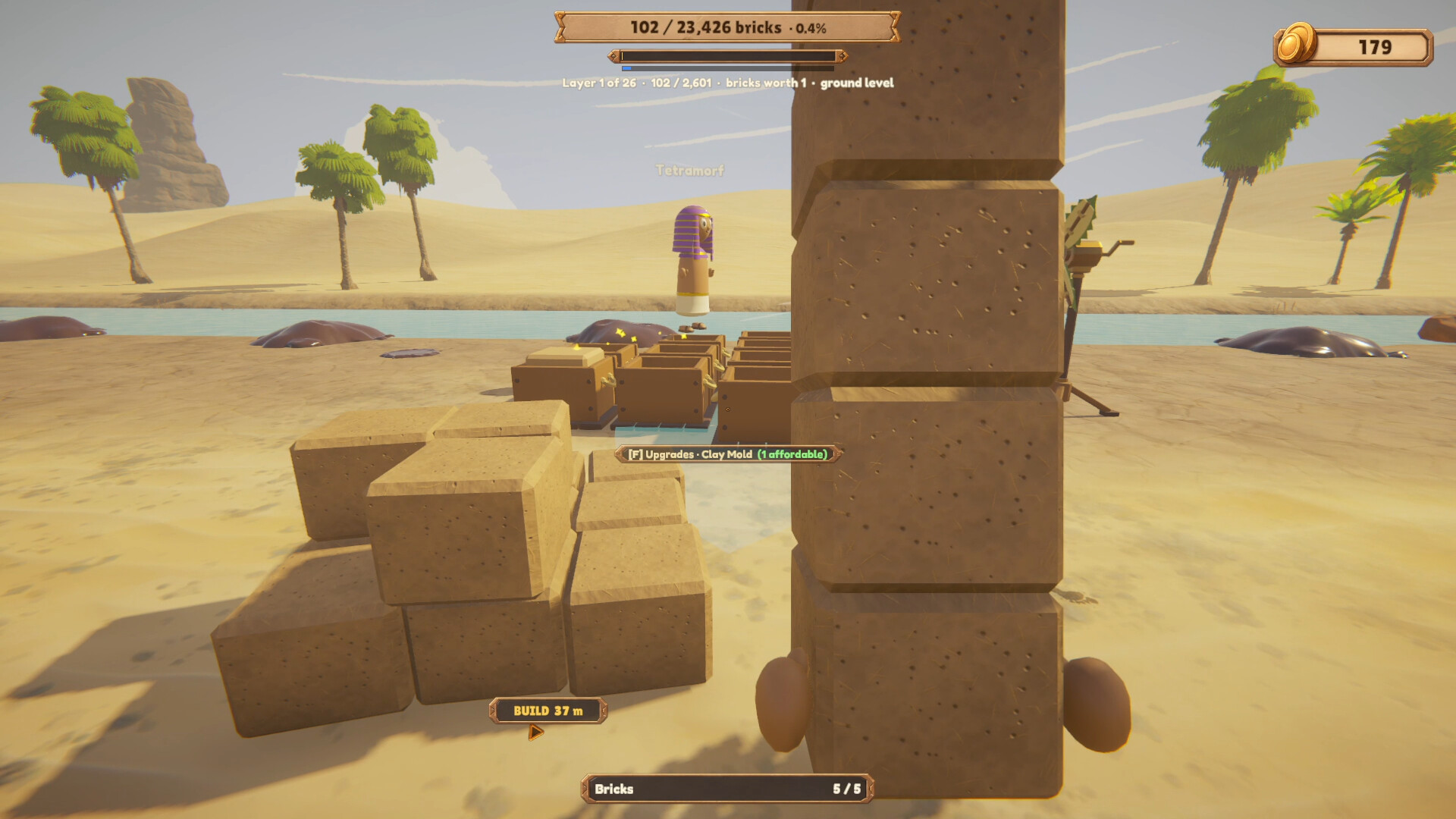
The overview of my two-player runs highlights the necessary factors for success: focus on achieving higher Prestige through the collection of golden bricks, understanding machine upgrades, and managing your workforce. These strategies unlock the path to monumental achievements.
How Prestige Scoring Works
Prestige is calculated by taking the raw points from the pyramid and applying the multipliers earned upon completion. Golden bricks, with a value of 30 points each, are prioritized on the exterior to maximize the bonuses extending to final scoring results.
Brick Values, Carvings, and Frieze Points
| Raw points | Value |
|---|---|
| Plain brick | 10 |
| Polished brick | 25 |
| Glazed brick | 60 |
| Golden brick | 300 |
| Carving on a brick | 3 × quality (about 290 at quality 97) |
| Outer ring brick, polished / glazed / golden | 15 / 45 / 160, plus 500 per finished ring |
| Carved outer ring brick | 120, or 180 with a frieze pattern |
| Frieze Master | 250 per brick of the longest unbroken frieze run |
| Gilded Cap (golden capstone) | 7,500 |
A pattern made using the Printing Press counts for frieze scoring; hand-drawn patterns do not. With press-carved outer-ring bricks, I can earn 180 raw points each, alongside Frieze Master rewards for the longest continuous carved sequence on a layer, impacting the overall score significantly.
Prestige Multipliers and Their Requirements
| Multiplier | Condition | Points | Factor |
|---|---|---|---|
| Golden Skin | every outside brick is gold | 100,000 | ×2.0 |
| Time | see table below | 0 | up to ×1.5 |
| Golden Tip | top 5 layers solid gold | 40,000 | ×1.15 |
| Hand-Made | at least 90% placed by hand or trolley | 0 | ×1.15 |
| Mirror Finish | no plain brick on the outside | 40,000 | ×1.1 |
The Golden Skin requirement counts gold bricks on the outer layer and the capstone. Hand-Made conditions apply only to manually placed bricks; automated placements should account for less than 10% of the pyramid to maintain the bonus.
Note that other workforce bonuses, such as those from trebuchets and Shabti, cannot stack with Hand-Made, but can be incorporated into your factory’s design to boost efficiency.
Time Bonus Limits for Classic and Grand Pyramids
The multiplayer model relies on how many players are present during the completion of the capstone; their participation before this point does not affect the time factor.
| Players at crowning | Classic ×1.5 | Classic ×1.25 | Classic ×1.0 | Grand ×1.5 | Grand ×1.25 | Grand ×1.0 |
|---|---|---|---|---|---|---|
| 1 | 8:00 h | 16:00 h | 30:00 h | 36:12 h | 72:23 h | 135:44 h |
| 2 | 5:39 h | 11:19 h | 21:13 h | 25:35 h | 51:11 h | 95:59 h |
| 3 | 4:37 h | 9:14 h | 17:19 h | 20:54 h | 41:48 h | 78:22 h |
| 4 | 4:00 h | 8:00 h | 15:00 h | 18:06 h | 36:12 h | 67:52 h |
Be cautious as exceeding the defined time limits results in a drop in the time factor, reducing your potential Prestige earnings. The timer only advances during active playtime.
Example: Reaching 168 Million Prestige
The documented Grand Pyramid recorded a total of 38,505,963 raw points. Incorporating multipliers like ×1.5 for time, ×2.0 for Golden Skin, and others results in a staggering final tally of 168,049,649 Prestige. Without Golden Skin, the same raw score would only yield about half that amount.
Factory Unlocks and Best Production Ratios
My factory is built around four Crucibles running at full heat, three Printing Presses upgraded to speed level 3, and aiming for approximately 12 gold chips produced per second. The accompanying setup should support this without falling behind.
Machine Unlock Requirements and Costs
Unlock conditions for machines rely on the number of bricks placed in the pyramid, remaining constant across Classic and Grand builds. As of version 0.42.1, players can unlock up to 16 instances of each factory building.
| Building | Unlocks at | First price | Each further one |
|---|---|---|---|
| Polishing Stone | 300 | 80 | |
| Glaze Kiln | 2,601 | 2,000 | +40% |
| Water Wheel | 3,500 | 1,600 | +10% |
| Pot Bellows | 3,600 | 900 | +25% |
| Sifting Tray | 5,002 | 250 | +25% |
| Gold Crucible | 5,002 | 1,500 | +40% |
| Printing Press | 6,000 | 4,000 | +35% |
| Clay Dredge | 6,000 | 3,000 | +50% |
| Gold Cradle | 9,236 | 2,500 | +40% |
I’ve learned to avoid buying machinery just to sell later; selling back within a minute nets a full refund while any later sales diminish the value.
Machine Output and Production Speed
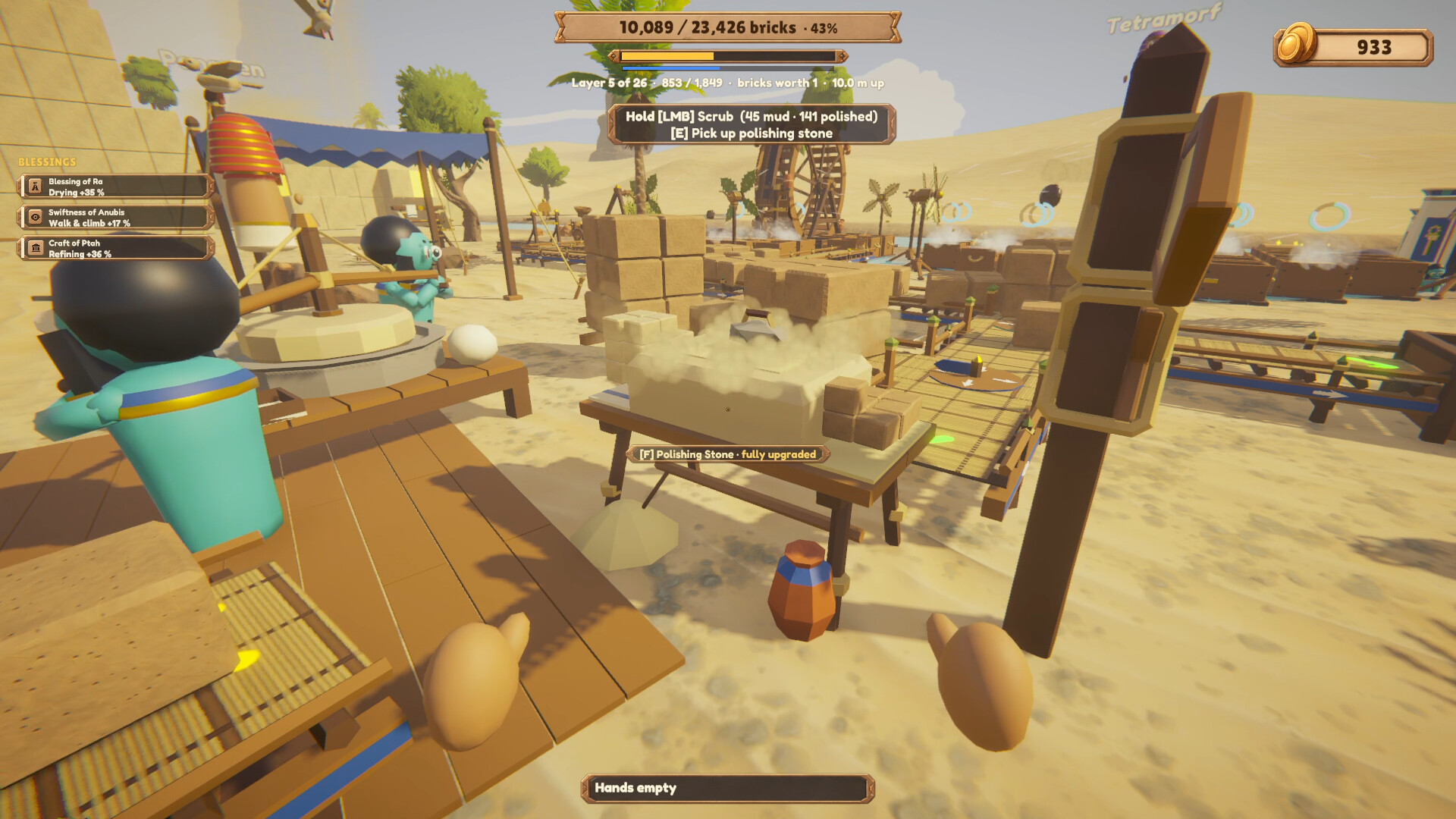
| Machine | Output | Notes |
|---|---|---|
| Sifting Tray with one Shabti | 80 to 100 g of clay per second, 0.3 to 0.4 chips per second | 4 chips per kg. A player with good rhythm reaches about 0.6 |
| Gold Cradle, no upgrades | 100 g per second, 0.3 chips per second | 3 chips per kg |
| Gold Cradle, speed 4, luck 3, golden Temple | about 1,100 g per second, 4.3 chips per second | 3.8 chips per kg. Uses over 4 t of clay per hour |
| Crucible, Shabti stoking | about 640 golden bricks per hour (measured) | Shabti heat stops at 75% |
| Crucible at 100% heat | 1,200 golden bricks per hour | Melts 3 chips per second. No upgrade raises this |
| Printing Press at 32 rpm, speed 1 / 2 / 3 | 720 / about 1,080 / 1,585 carvings per hour | More than 32 rpm adds nothing |
Being mindful of the heat is crucial for a Gold Crucible’s output. A Shabti managing the fire reaches only a maximum of 75% heat—an essential factor, while pressing the speed limit of a Printing Press yields no additional benefits after 32 rpm.
Gold Chips Required for Each Golden Brick
| Brick fed into the crucible | Normal heat | White-hot (85% and above) |
|---|---|---|
| Plain | 20 | 15 |
| Polished | 16 | 12 |
| Glazed | 12 | 9 |
Whenever possible, I emphasize using glazed bricks in the Crucible while maintaining heat at 85% or higher, as this reduces the gold chips needed for each brick.
Best Crucible and Printing Press Ratio
An efficient setup requires a single Crucible at 100% heat with this input and press ratio:
| It needs | Amount |
|---|---|
| Gold chips | 3 per second |
| Cradle output shown in game | 790 g per second at luck 3, 1,000 g per second at luck 1 |
| Presses at speed 1 | 1.7 |
| Presses at speed 2 | 1.1 |
| Presses at speed 3 | 0.76, so 4 crucibles to 3 presses |
| Sifting Trays with Shabti (before cradles) | 8 to 10, so all 16 trays feed about two crucibles |
With properly upgraded presses, three are sufficient for approximately four fully operational Crucibles. Prior to unlocking Gold Cradles, the factory’s productivity is limited by Shabti-operated Sifting Trays.
Factory Upgrades Worth Buying
| Building | Upgrade | Total cost |
|---|---|---|
| Printing Press | speed to level 3 | 10,500 |
| Printing Press | plate, lowest carving quality 85 to 95 | 8,000 |
| Gold Cradle | speed to level 4 and luck to level 3 | 33,500 |
| Pot Bellows | draught to level 3 | 5,200 |
| Crucible | pouring and pot to level 3 | 8,800 |
The setup with 16 Crucibles and 16 Printing Presses has produced around 19,200 carved golden bricks per hour, making Crucible output the bottleneck in production.
Glaze, Clay, and Gold Supply Chain
| Machine | Output | Notes |
|---|---|---|
| Glaze Kiln as bought | 1,200 glazed bricks per hour | 3 s per brick. Feeds exactly one crucible |
| Glaze Kiln, speed level 4 | 4,000 per hour | 0.9 s per brick. The three upgrades cost 29,000 |
| Glaze Kiln, speed level 4, golden Temple | about 15,000 per hour | Feeds 12 crucibles. A shaft at 32 rpm doubles it |
| Clay Dredge as bought | 1,200 g of clay per second | At a 16 rpm shaft or with one average Shabti. Digs nothing without a drive. Feeds one fully upgraded cradle |
| Clay Dredge, output level 4, 32 rpm | 7,200 g per second | Feeds six fully upgraded cradles. The three upgrades cost 36,000 |
| Mud Wheel | 250 g per second as bought, 1,375 at output level 5 | Too little for cradles |
Before increasing the Gold Cradle line, I evaluate the clay supply and ensure the system is adequately powered to meet demands. A fully upgraded Glaze Kiln also enhances grain output significantly over an unupgraded model.
Power Sources, RPM, and Stress
Power sources have a fixed Stress capacity while machines apply Stress depending on their rpm settings. If a network demands more than the available Stress capacity, it leads to slower machine operation.
| Source | Speed | Stress it carries |
|---|---|---|
| Water Wheel | 8 rpm | 256, boosts to about 320 with Shabti |
| Treadwheel with one Shabti | 16 rpm | 320 |
| Hand Crank with one Shabti | 8 rpm | 64 |
Understanding that each Printing Press consumes 12 Stress per rpm is vital. To ensure smooth operation, power adequately to meet demand without throttling the production speed.
Coins Earned When Placing Bricks
Each time a brick is placed, players earn coins based on the layer’s value. This can multiply by factors of ×30 for golden bricks, significantly impacting resource acquisition.
Shabti Jobs, Prayer, and Monument Bonuses
Assign Shabti roles according to their relevant attributes like Strength, Speed, Stamina, and Skill for optimized production. Each job will benefit from specific attributes, so make assignments carefully for maximum efficiency.
Best Shabti Attributes for Each Job
Job Strength Speed Stamina Skill Praying 0 0 40% 60% Rocking a cradle 70% 0 30% 0 Sifting 70% 0 0 30% Stoking a glaze kiln 20% 0 20% 60% Blowing at a crucible 0 0 70% 30% Polishing 30% 0 0 70% Cranking (hand crank) 70% 0 30% 0 Hauling and mud carrying 50% 50% 0 0 Running (treadwheel, mud wheel) 0 70% 30% 0
Utilizing the Scarab-kissed trait boosts chip gathering at Sifting Trays and Gold Cradles. If two Shabti work together, they both need to possess this trait for the maximum profit.
How Prayer Improves Production
Starting with two prayer seats on a completed monument, upgrades can increase this to four. Prayer efforts can raise production significantly, but benefits from additional worshippers diminish.
Prioritizing prayer at a golden Temple can amplify chip production notably, transforming outputs substantially when focused on refining capabilities.
Plain monuments do not yield significant benefits compared to their golden versions; this inefficiency makes assigning more than one Shabti there not worthwhile.
Monument Materials and Golden Bonuses
Monument blessings depend on the materials used: plain ×1.0, polished ×1.35, glazed ×2.4, and golden ×11.15 . A golden monument’s advantage provides an exponential increase in the benefits received during construction.
| Monument | Bricks | Blessing | Plain | Golden |
|---|---|---|---|---|
| Obelisk | 151 | drying speed | +25% | +279% |
| Anubis | 228 | walking and climbing speed | +12% | +134% |
| Temple | 407 | polishing, glaze kiln, cradle, crucible pouring | +25% | +279% |
| Sphinx | 460 | coins per pyramid brick | +15% | +167% |
| Colossus | 755 | bricks carried per stack | +3 | +33% |
Investing in golden monuments is wise for maximizing economic return—especially at the Sphinx and Temple. Transitioning from plain to golden constructions requires tear-down and rebuilding, which incurs costs and time, so plan upgrades accordingly.
Grand Pyramid Build Order for Golden Skin
The Grand Pyramid consists of 43 layers and 105,995 brick positions , permitting teams of up to 16 players to collaborate. The placement strategy is vital as it allows placeholders for interior bricks without prematurely committing to gold production.
Step-by-Step Golden Skin Build Order
0 to 5,002 bricks: Initiate by filling the inner layer of layer 1, avoiding any outer ring placement until the interior is done. Transition to using glazed bricks as soon as the Glaze Kiln is operational without halting construction. At 5,002 bricks: Unlock the Gold Crucible, attach Pot Bellows, and operate Sifting Trays with Shabti. Continuous Glaze Kiln operation is necessary for adequate glazed inputs. At 6,000 bricks: Unlock the Printing Press and construct a golden Sphinx to enhance the coin earnings. Complete the first outer ring: Carefully place only press-carved golden bricks around the outside of layer 1, conserving uncarved gold for the interior. Before 9,236 bricks: Build the Temple out of gold to maximize the refining speed of Gold Cradles. At 9,236 bricks: Unlock Gold Cradles, add Pot Bellows, and upgrade Printing Presses to speed level 3. Scale Crucibles and presses as per need and clay production rates. Improve placements: Gather the Anubis and Colossus monuments for enhanced movement and carrying capacity while implementing conveyor belts for streamlined brick movement up the structure. Before placing the capstone: Double-check that every exterior brick is golden and carved, ensuring the top layers are solid gold and the capstone is also golden without any carved bricks resting in storage.
Recorded Two-Player Build Milestones
Milestone in our run (2 players) Play time 5,002 bricks, crucible 2:32 h 9,236 bricks, cradles 5:07 h 13 presses, about 9,000 bricks per hour 6:40 h Half of all bricks 8:32 h Capstone 11:26 h
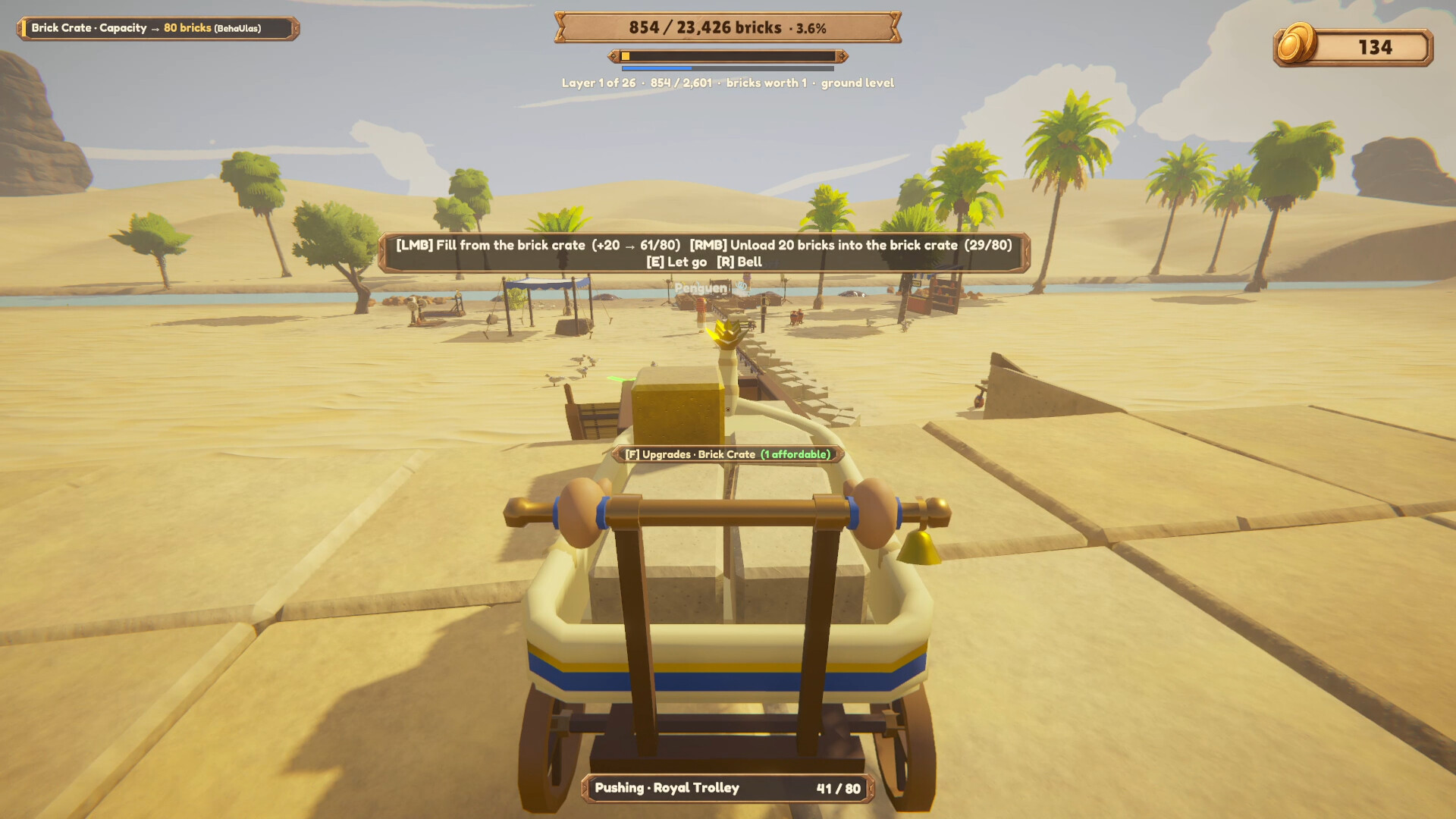
The two-player run, especially after the seventh hour, managed an impressive rate of 15,000 to 23,000 hand-placed golden bricks per hour, leading to crowning the Grand Pyramid in just under 11 hours and 26 minutes.
Mistakes That Slow Down the Build
Repeatedly selling and replacing machines: financially counterproductive, as refunds drop considerably past the initial minute. Adding Crucibles too early: these can hinder progression without sufficient gold chips needed for production. Keeping Printing Presses at speed level 1: insufficient speeds can limit overall factory output drastically. Using a Shabti on a Crucible already with Pot Bellows: unnecessary since Shabti can’t enhance heat past 75%.
A different approach would be necessary on a Classic Pyramid which presents distinct challenges; the volume of exterior bricks that must be placed limits the potential for achieving Golden Skin in that format.
Carving Limits, Chisel Costs, and Other Scoring Details
Printing Press Carving Limits
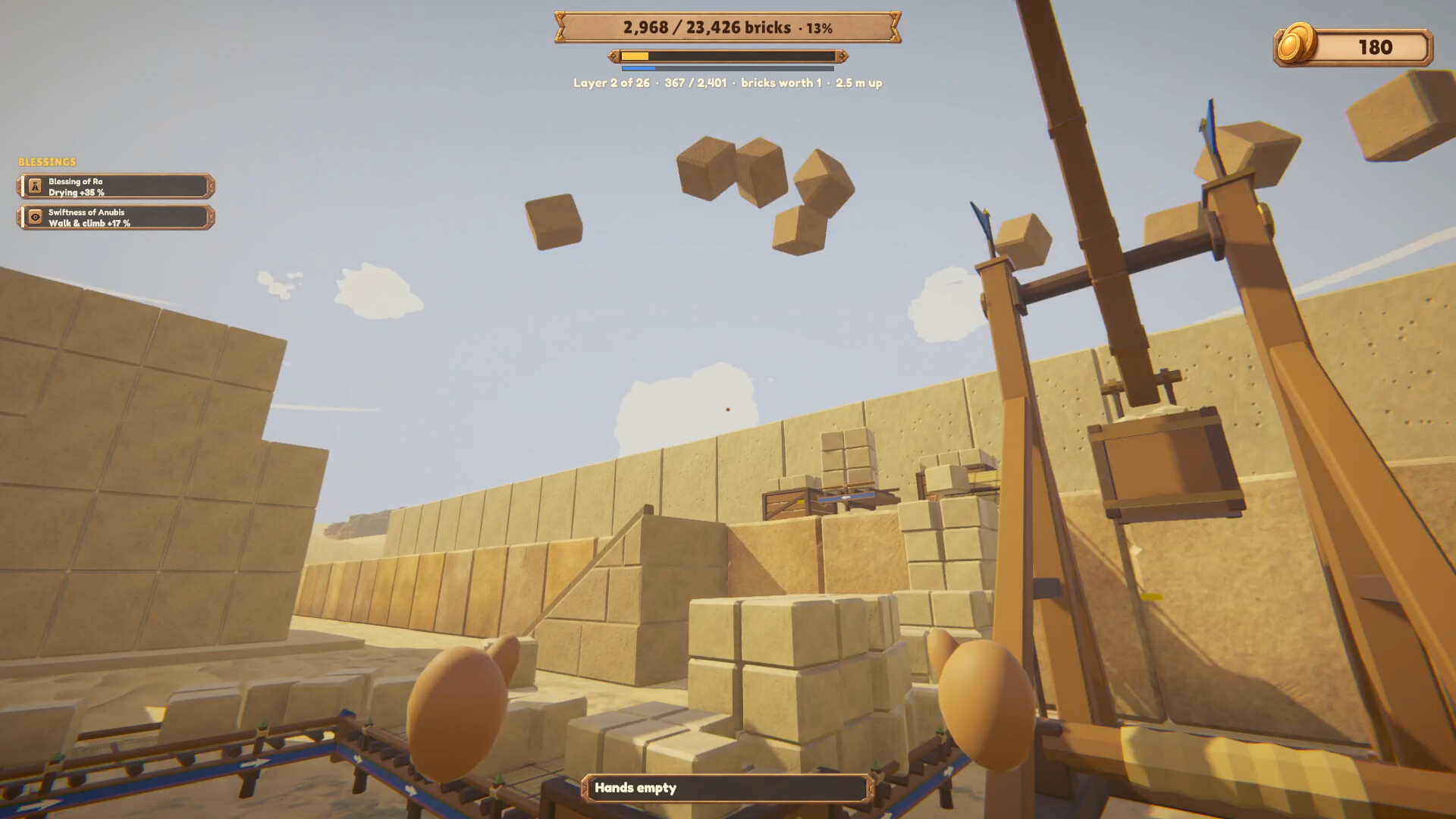
A game world can support up to 20,000 press-made carvings , alongside 600 hand-drawn carvings . When limits are reached, new carvings replace the oldest pressed ones stored within the pyramid.
Move brick carvings into place prior to crowning, as only painted bricks visible on the exterior will contribute towards scoring. Scoring on the exterior remains a top priority.
Chisel Removal Fees
Chisel removal applies exclusively to exterior bricks; the first cost is 250 coins while every subsequent one increases by 6%. Removing multiple bricks can become expensive, particularly for significant replacements towards the pyramid’s final shaping.
Golden Brick Event
A special golden brick event triggers after placing 200 bricks; participants have 90 seconds to collect the golden brick worth 30 times the coin value of a regular brick from the active layer. Failing to collect it transforms it back into a normal brick.
Awards and Their Prestige Values
Awards, though trivial in total points compared to raw pyramid scoring, reward significant contributions to the pyramid effort. The combined value for awards totals a mere 15,001 points, not to be relied upon for strategy on the leaderboard.
| Award | For | Raw points |
|---|---|---|
| Chief Architect | most bricks placed by hand | 2,500 |
| Midas | most golden bricks placed | 2,500 |
| The Scribe | best single carving on the pyramid | 2,000 |
| Mudslinger | most clay scooped, over 1 kg | 1,500 |
| Middle Manager | most Shabti hired | 1,500 |
| Trebuchet Enthusiast | most volleys fired | 1,500 |
| Best Çaycı | most glasses of tea served | 1,500 |
| Bazaar Tycoon | most coins earned | 1,000 |
| Trolley Captain | most bricks wheeled into the walls, at least 50 | 1,000 |
| Professional Napper | fewest bricks placed | 1 |
Note that even a significant contribution from a trebuchet volley might not count towards an award if it does not qualify under set conditions.
In the recorded run, a trebuchet volley placed 97 bricks, but the Trebuchet Enthusiast award was not awarded for that volley.