
Message From Aliens challenges players with its unique blend of puzzle-solving and alien language interpretation. In this walkthrough, I’ll guide you through the first two chapters, focusing on the essential mechanics and puzzle solutions you need for success. Pay close attention as each chapter introduces new concepts that build on the previous ones, and you’ll gain valuable insights as you progress.
As you dive into the game, the initial learning curve might catch you off guard, especially when it comes to deciphering symbols and understanding the arithmetic in Chapter 1 followed by the geometric concepts in Chapter 2. It’s easy to get lost if you miss a crucial translation or mathematical rule, so stay sharp! The game rewards thorough exploration and careful reading.
Make sure to familiarize yourself with the basics before starting these chapters. Understanding the controls and how to navigate through the textbook will save you time. You’ll want to start with problem-solving materials ready, as they’re critical in helping you tackle the challenges ahead.
Walkthrough: Chapter 1 and 2 Answers
Let’s kick things off with a look at basic controls before we jump into the puzzles. Chapter 1 mainly deals with arithmetic while Chapter 2 introduces geometry.
Keeping track of important symbol clues is crucial, as they’ll help you navigate through the problems effectively. This way, you won’t lose your place in the textbook while working through the levels.
How to Play Message From Aliens
Basic Controls
Here are the controls to get you started:
- The left side displays pop-up messages; you can skip these initially.
- Move between screens by clicking the underlined text on the right side.
- Click the question mark below a character to jot down notes.
- Use the button in the upper-right corner for ending the game or returning to the previous screen.
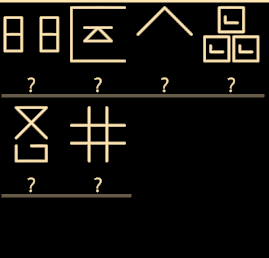
Textbook and Options
At the game’s start, you’ll have access to just two menus: Textbook and Options.
Adjust the screen size from the options available and experiment with them until you’re comfortable. Most of your progress will come from deciphering the Textbook, so it’s worth spending some time getting used to it.
Your next focus should be navigating effectively through the Textbook.
Chapter 1 Walkthrough – First Half
Getting Started: Problem 1
When Chapter 1 opens, you might find some entries are blank. The first one is a Problem page where you’ll need to fill in outlined boxes with appropriate symbols.
For the first problem, you can choose from symbols like |, ||, and |||. Placing your choice in the box confirms its correctness with an on-screen change. It’s a simple first step that makes it easier to get your bearings.
Problem 1 answer: ||. This is essentially creating an arithmetic sequence with a difference of 1.
How I Read the Alien Dictionary
For a Text page, clicking on a character brings up its dictionary entry on the left. This entry tells you the part of speech, radical, and definition allowing you to assign meanings effectively.
Texts 1-5 and Problems 2-3
- Text 1 – Addition: This passage serves as an introduction to the addition process, be mindful of symbols = and ≠.
- Text 2 – Subtraction: I focus here on ensuring I understand the concept without confusing it with negative values.
- Problem 2: The equations are ? − 2 = 3 and ? + 2 = 3, yielding answers of 5 and 1.
- Text 3 – Multiplication: You’ll notice number representations from 8 onward appear different; they utilize a modified base-7 notation.
- Text 4 – Division: Division concepts are clearly explained here.
- Text 5 – Remainders: Remainders are introduced, rounded off in this section.
Problem 3: The equation reads 26 ÷ 3 = ?? remainder ?, provided answers are 71 (8) and 2.
Texts 6-11: Variables, Fractions, and Order
Moving forward, I flip the textbook page.
- Text 6 – Variables: This covers variables and expressions like if…then; valuable notes that I make.
- Text 7 – Fractions: Introduction to fractions takes a unique turn, as denominators are powers of 7.
- Text 8 – Comparisons: Identifiable terms appear regarding comparisons with symbols that suggest relationships, such as larger, smaller.
- Text 9 – Repeating Decimals: The explanation of decimals in base 7 presents a challenge since it doesn’t switch to base 6 for decimal notation.
- Problem 4: You solve this with 1.?… = 2, where I enter 6.
- Text 10 – Order: Here, I encounter important terms like inside and next.
- Problem 5: I derive the sequence from X to Y and Z to fill in the blanks: X, Z, Y.
- Text 11 – Maximum and Minimum: Observations connect symbols with larger or smaller values, aiding comprehension.
Page 3: Texts 12-18 and Problem 6
- Text 12 – True and False: I recognize these as truth values, equivalent to yes and no/not.
- Text 13 – Logical AND and OR: Here, I learn the expressions equivalent to and as well as or.
- Problem 6: Addressing the four statements helps me identify relationships using is, is, is not, is not.
- Text 14 – Numbers and Numerals: I differentiate between a number and numeral, gaining a key understanding here.
- Text 15 – Sets and Things: Sets are introduced with the terms for connect and element.
- Text 16 – Inside and Not Inside: I learn to categorize objects based on these translations.
- Text 17 – Singular and Plural: The ideas of one, multiple, and pair are clarified.
- Text 18 – All and Some: I note abstract terms emerging, even though I’m still within Chapter 1.
Chapter 1 Walkthrough – Second Half
Page 4: Set Problems, Powers, and Logarithms
- Problem 7: Analyzing the set {1, 2, 3, 4, 5, 6, 7} leads me to find values greater than 3 and less than 3, yielding 4, 2, 7, 1.
- Problem 8: From the sets {2, 4, 6} and {3, 6}, I identify corresponding values with 6, 2, 4, 3.
- Text 19 – Powers: An introduction to exponentiation occurs here.
- Text 20 – Logarithms: The concept of logarithm or log is nicely introduced.
- Text 21 – Halves: The topic of half relates to roots.
- Problem 9: Given ? squared = ? cubed + 1, I enter 3 and 2.
- Problem 10: A logarithm relation with variables X, Y, and Z is tested.
- Text 22 – Base-7 Exponential Notation: Understanding this ties to writing × 7^ in their notation.
Page 5: Approximations and Calculation Order
- Text 23 – Approximation: A clear understanding of ≈ is vital.
- Problem 11: I fill in the approximation for √2 ≈ 1 + ? and √3 ≈ 1 + ?, yielding 3/7 and 5/7.
- Text 24 – From and To: Terms are learned for from and to.
- Text 25 – For and By: I interpret in order to/for and by means of.
- Text 26 – Increase and Decrease: I identify key concepts and their opposites.
- Text 27 – Calculation Order: The aliens calculate left to right without the usual order of operations.
- Problem 12: I fill in 1 ? 2 ? 3 ? 4 = 14 with ÷, +, ×.
This wraps up Chapter 1, unlocking automatic number-notation conversion. Since numbers play a significant role, moving onto the next chapter feels essential.
Chapter 2 Walkthrough – First Half
The Guide and the Title-Screen Minigame
Before diving into the new texts, I find a guide button at the upper right for further assistance. Although some parts may be unreadable at first, it’s worth checking out.
There’s also a minigame accessible from the title screen. While not essential for the walkthrough, it provides valuable context with helpful instructions including terms like right and swap.
Text 1: Circles and Pi
Jumping into Chapter 2, I immediately recognize it as a more challenging section. Here’s where I encounter the character resembling ^, indicating it as a meaning of of.
Finding ≈ 22/7 gives me confidence that the leftmost symbol stands for pi (π). From there, I decode the formulas:
- Area of a circle: π × radius squared.
- Circumference formula: π × radius × 2.
- Area reacts to the shape’s properties.
- Circumference corresponds to the boundary length.
- Length defines a line segment leading to the circle’s center.
- A circle is defined by its looping line.
Here, Chapter 2’s geometry theme becomes evident.
Text 2: Points and Lines
Terms for infinitesimal, infinite, curve, and straight line arise; notably, the word interpreted as straight line translates to line segment in Earth terms.
I reference dictionary entries to test possible meanings for terms like connect or link together, confirming their accuracy.
Problem 1: Circle Circumference and Area
For the problem asking the circumference of a circle with radius 1 and area of a circle whose circumference is π, I rearrange and determine the answers: × 2 and ÷ 4.
Text 3: Angles and Radians
This section discusses angles, indicating radians as the method for measuring angles (a full circle is 2π).
Text 4: Quadrilaterals
I delve into quadrilaterals, noting the introduction of terms implying flattened regular polygons, specifically referring to rectangles .
Problem 2: Equilateral Triangles
Equilateral triangles are explained as three equal-length sides which help with perimeter and area calculations using × 3 , ÷ 3 , and ÷ 4 .
Text 5: Vectors and the Dictionary Shortcut
Learning about vectors , I also find directional terms. A useful tip: understanding vector characters allows easy use of the Guide for translation.
This includes right-clicking to access dictionary entries while reading through problem text or dictionary definitions, enhancing my understanding further.
Problem 3: Inverse Operations
Identifying the inverses for addition, multiplication, and exponentiation reveals answers of subtraction (−), division (÷), and logarithm.
Chapter 2 Walkthrough – Second Half
Page 2: Three-Dimensional Shapes and Coordinates
Text 6 – Three-Dimensional Shapes: Learning about three-dimensional shapes underlines terms for volume and faces/surfaces . Problem 4: Sphere volume as a three-dimensional shape is articulated with circumference and radius expressions. Text 7 – Cylinders and Cones: Terms are birthed such as circle + column to express cylinders. Problem 5: Counting faces of polyhedra outlines answers: 4, 8, 20, 6, 12 . Text 8 – Right Triangles: Right triangles explained with reference to the Pythagorean theorem . Text 9 – Coordinates: Notable patterns in radicals explain position and coordinate . Problem 6: I evaluate the distance yielding familiar values in 3, 4, 5 . Text 10 – Congruence and Similarity: The introduction of congruence and similarity encapsulates vital geometry concepts.
Page 3: Ellipses and Problem 7
- Text 11 – Ellipses: I conceptualize an ellipse as a compressed circle introducing central features.
- Problem 7: The ellipse exploration emphasizes the relationship with distance to foci and responds using 3 and a square-root symbol.
As for the ellipse with major diameter 2 and minor diameter 1, I decipher the quest for the distance from the center to a focus, resulting in a tough formula-based approach.
Post Chapter 2, I’ve unlocked the Incremental minigame and Chapter 3 along with page bookmarks. This feature allows me to mark pages for quicker navigation in future gameplay.
While the calculations grow in complexity, I’ve made headway through the challenges posed mainly at Chapter 2.
After Chapter 2, I unlock the Incremental minigame and Chapter 3. I also unlock page bookmarks: a Mark button appears near the page-turn control, letting me mark texts and problems and jump to those pages from the title screen.
The calculations become harder from here, but I have already worked through one of the biggest obstacles: the beginning of Chapter 2.